
 Skip to content
 One diagnostic. Six pillars. Three delivery frameworks. Built across two decades of sales transformations applied, tested, proven in the field from start-ups to multinationals.
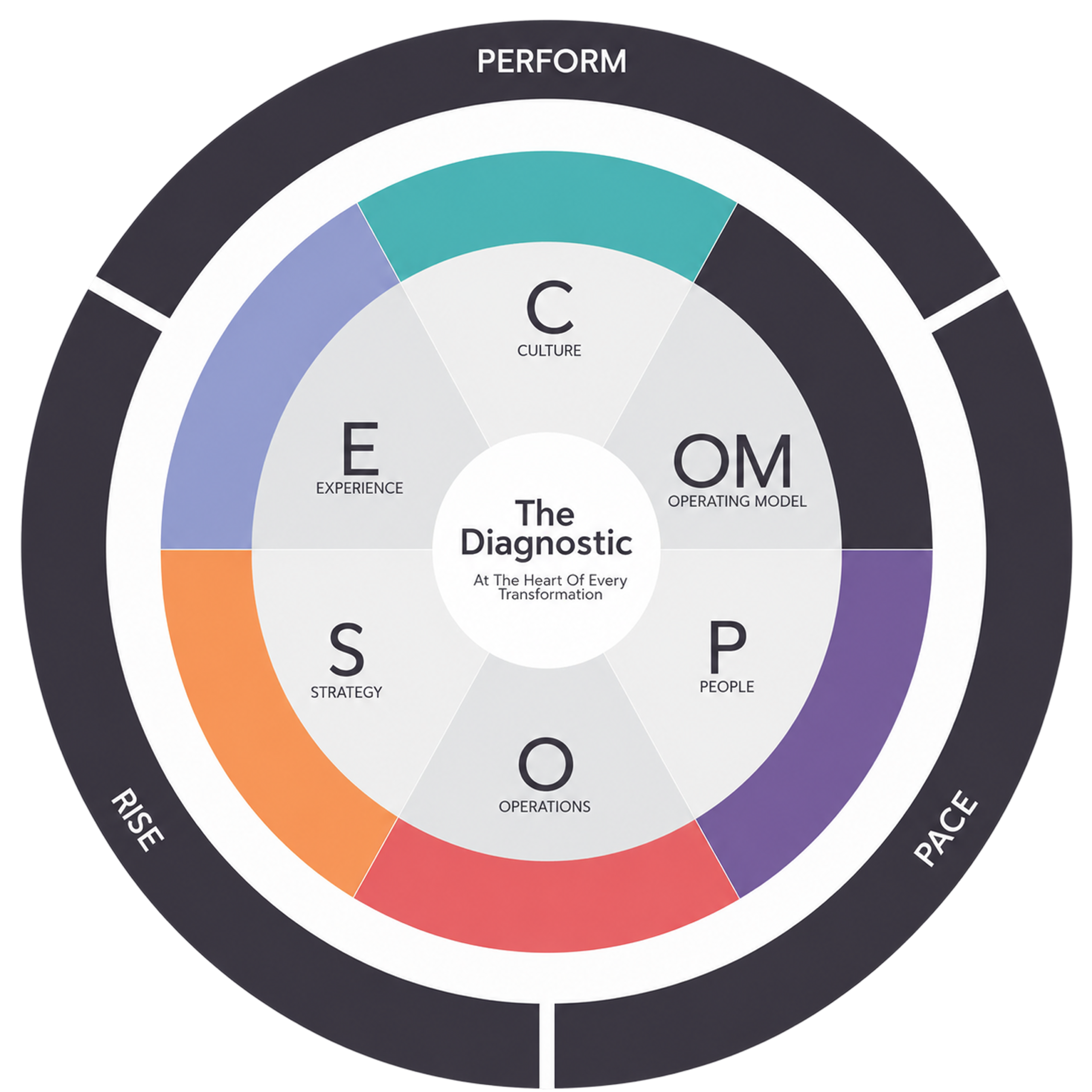
After nearly twenty years in various sales transformations spanning strategy, operating model, process design, system implementation, enablement and operations, we built a model that encompasses it all.
From global to regional. Matrixed to simple. Proven at scale, flexible by design.
Years building it, inside real commercial functions
sellers in the largest organisation it has been applied in
Regions the model has been tested in: EMEA, Americas and APAC
Organisation reference points that showed our diagnostic works
Two decades of running commercial functions inside global technology, software, telecommunications and information services businesses made one pattern unmistakable. Coverage, segmentation, op model, organisation, process, capability, data and the way leadership inspects performance all pull on each other. Get them aligned and growth compounds. Fix one in isolation and the organisation absorbs the change without improving.
Plenty of frameworks handle one part of that well. Strategy houses design the go-to-market. Enablement vendors build capability. Systems integrators fix the tooling. Each is genuinely good at its piece, and each hands you a piece.
The COMPOSE Sales Model® was assembled the other way round. Not designed as a methodology and then applied, but built across live transformations, refined each time something failed to hold and rebuilt around what did. It covers the whole commercial function in one structure, and it is a UK registered trademark.

The COMPOSE Sales Model® is our own. Three elements, built to work together, covering every part of a commercial organisation. Evidence first, then the full picture, then delivery.
Understanding where you are
Forty-five critical dimensions, assessed four ways: interviews across leadership, managers and sellers, surveys, performance analysis, and time and motion. It establishes where growth is capped and what it is worth going after.
Our connected components
Culture, operating model, people, operations, strategy and experience. Every commercial organisation is built from these six. Assessed individually, judged as a system, because the weakest sets the ceiling on growth.
How the work gets done
PERFORM, PACE and RISE carry the diagnosis through to a working function. Which apply, and in what order, is set by the evidence. Each is built with your team so it runs without us.
Everything starts here. Forty-five critical dimensions of the commercial function, assessed four independent ways.
What you get is not forty observations and a recommendation to do everything. It is a clear, evidenced picture of where you stand, a prioritised list of what to fix and in what order, a view on the value at stake, and a board-ready summary you can act on.
with sales leadership, front-line managers and functional leads for their insights.
To the broader sales organisation for annonymised inputs directly from the field
Market size, attach rates, pipeline, forecast, attainment, win-loss and segment insights.
Where the sales organisation actually spends its week.
Together they form the basis of a single transformation plan, built with your leadership team.
How it runs, what you get, and why it is the right place to start.

Every sales organisation is built from the same six. What differs is how well they hold together.
They are assessed individually and judged as one system, because strength in one rarely compensates for weakness in another. The weakest of the six sets the ceiling on growth.
How performance actually gets led
How the function is built for market
Segmentation, coverage, channel mix, function set-up, territory design, organisation, roles, spans of control and mutual accountabilities cleanly aligned and ready to operationalise.
Customer, partner and seller, as one
Roles, competencies, hiring profiles, onboarding, capability development, coaching and incentive interlock, designed so the model works for the full commercial organisation.
How selling actually runs each week
Sales process, stage definition, qualification, forecasting, pipeline management, CRM architecture, data quality and the execution rhythm that makes disciplined selling the default.
Where growth is supposed to come from
Market size, growth strategy, target markets, segment priorities, value proposition and go-to-market design, so the number has deep insight rather than an assumed positions.
Who does the work, and how they improve
Customer journey, partner engagement and seller experience, designed together rather than separately, because friction in any one of the three is felt immediately by the other two.
PERFORM, RISE and PACE carry the diagnosis through to a transformation that executes with a handover to a function that runs on its own.
Which frameworks apply, and in what order, is set by the need. Each is built alongside your team, so what is delivered is already theirs by the time it goes live.
A commercial function designed for the market you are actually chasing.
Where you compete, how you cover it, and how the organisation is built to deliver. This is the framework that decides how much growth is available before a seller picks up the phone.
Growth strategy, markets and value proposition
Coverage, segmentation and route to market
Territories, quota, capacity and economics
Roles, structure, spans and accountability
The foundation everything else depends on, finally built properly.
Clean data, a process people actually follow, systems that talk to each other, and a rhythm that holds. This is the work most organisations skip, and the reason AI investment returns nothing.
Sales process, stages and qualification
Quality, governance, reporting and insight
CRM architecture, tooling and AI readiness
Cadence, inspection and forecast discipline
Sellers who know what to say, and pipeline that arrives on purpose.
Capability, energy and demand, built together. What sellers and leaders say, how they are developed, and how pipeline is created. Enablement is a strategic lever, not an optional one.
Demand generation and repeatable sales plays
Onboarding, ramp, competency and certification
Messaging, assets, governance and findability
Communications, events, launch and adoption
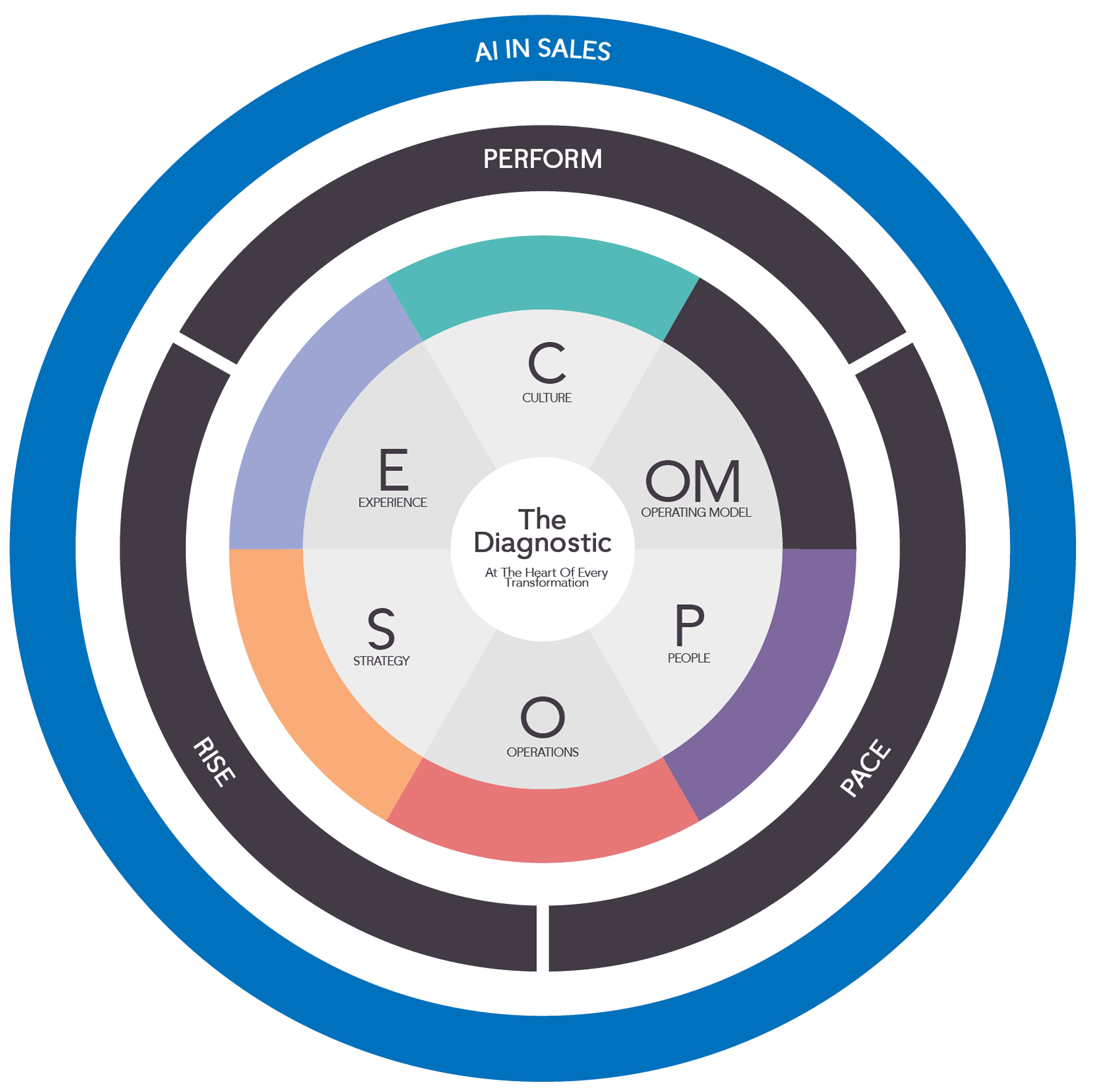
Most AI investment in sales has returned very little. Spending has been heaviest in commercial functions and measurable impact thinnest, and the reason is rarely the technology. It is AI applied to a function whose process, data and roles were never designed to carry it.
So AI is not a seventh pillar. It runs through all six: smarter targeting in strategy, better coverage in the operating model, faster ramp for people, sharper forecasting in operations. The gain is real in each one, but only where the work has been redesigned around it.
None of it holds without clean data and a process people follow. That foundation sits in RISE, and it is the work most organisations skip.

Managing Partner
Six years ago we automated activity capture into a client's CRM. Nobody called it an AI project at the time. It was disciplined data capture, embedded into how sellers worked, operationalising their qualification method and supporting managers to coach to it rather than report on it. That client now runs AI pipeline inspection, forecasting, next best action and early agentic use on that very data. The real advantage of AI comes from clear process and good data foundations."
Worth a conversation first. How we approach this, where we would start, and whether it fits what you need. Nothing more than that.

A practitioner-led sales transformation practice anchored on the COMPOSE Sales Model®.
Copyright © Compose Sales Partners™ Limited. COMPOSE Sales Partners™, the Compose Sales Partners™ logos, COMPOSE Sales Model® is a trademark and service mark of COMPOSE Sales Partners™ Limited. PERFORM, PACE, and RISE are proprietary frameworks of COMPOSE Sales Partners™. Other brands and product names are the trademarks of their respective companies.

The challenge
An award-winning commercial enablement function had to be designed and built from the ground up, covering plays, academy, content, engagement, and the platform that runs them. The bar was set high. It had to be measurable, evidenced, and connected to revenue outcomes, not a content library.
What was done
· Designed and led the full commercial enablement function as the accountable VP. Owned the operating model and all four Centres of Excellence (Plays and Pipeline Creation, Academy, Content, Engagement).
· Built the three-tier sales play system from Anchor Value Story through Core Value Propositions to Tactical Plays, with bill of materials and activation.
· Built the Pipeline Creation engine. Cadenced prospecting, marketing-sales-product-inside-sales interlock, pipeline coverage as the managed outcome.
· Built the Academy across Foundations (Ready to Sell), Skills by role, and the Leadership Academy with a proprietary hiring framework.
· Architected the content discipline (hero/L1/L2/L3 tiering, governance, decay management).
· Selected and led implementation of the enablement platform. Designed the engagement model (manager rhythms, deal coaching, flagship events) with a single voice across all of it.
Outcome
Internal Innovation Award for the function and approach. Pipeline coverage uplift of 1.7x to 3.2x off a €6.5 million sales kick-off event spanning 1,650 people. Material improvement in onboarding-to-productivity time. Play adoption and content engagement evidenced at function level. A manager layer enabled to coach deals rather than chase forecasts.

The challenge
The corporate sales function needed a new strategy and a partner programme designed to extend reach into segments the direct organisation could not cover economically. The existing partner motion was disconnected from the direct go-to-market, with overlapping accounts, unclear economics, and inconsistent value propositions.
What was done
· Designed the corporate sales strategy. Segmentation, coverage, channel mix.
· Designed and operationalised the partner programme. Tiering, enablement, deal registration, partner business plans, economics.
· Aligned partner and direct motions to remove conflict and create complementary coverage.
· Led the rhythm of business and reporting that gave leadership confidence in partner-sourced and partner-influenced revenue.
Outcome
Coherent partner programme operating in market with clear economics. Partner-sourced and partner-influenced revenue evidenced through structured reporting. Direct and indirect motions complementary rather than competing.

The challenge
Following a major acquisition, two commercial organisations had to be integrated into one without losing the run-rate. Operating models, processes, tools, plays, and ways of working were duplicative, inconsistent, and slowing the combined organisation down. Sellers were navigating two systems and two cultures.
What was done
· Designed the unified commercial operating model post-merger. Segmentation, coverage, organisation design, role architecture, decision rights, governance.
· Designed the unified enablement function using the PACE framework. Single plays system, single Academy, single content discipline, single engagement model.
· Led the lead-to-cash process rationalisation and the supporting architecture decisions.
· Built the rhythm of business and forecast discipline that gave the combined organisation a single source of truth.
· Mobilised the cultural integration alongside the structural one. Recognition, communications, manager activation.
Outcome
Combined commercial organisation operating as one inside the integration window. Orders growth of +2.4 percent representing $6.7 million across more than 2,000 sellers. Sellers operating on a single set of plays, content, and processes across the combined business. Internal Transformation Award.

The challenge
Following a major acquisition, two commercial organisations had to be integrated into one without losing the run-rate. Operating models, processes, tools, plays, and ways of working were duplicative, inconsistent, and slowing the combined organisation down. Sellers were navigating two systems and two cultures.
What was done
· Designed the unified commercial operating model post-merger. Segmentation, coverage, organisation design, role architecture, decision rights, governance.
· Designed the unified enablement function using the PACE framework. Single plays system, single Academy, single content discipline, single engagement model.
· Led the lead-to-cash process rationalisation and the supporting architecture decisions.
· Built the rhythm of business and forecast discipline that gave the combined organisation a single source of truth.
· Mobilised the cultural integration alongside the structural one. Recognition, communications, manager activation.
Outcome
Combined commercial organisation operating as one inside the integration window. Orders growth of +2.4 percent representing $6.7 million across more than 2,000 sellers. Sellers operating on a single set of plays, content, and processes across the combined business. Internal Transformation Award.

The challenge
A multinational B2B business needed to reset enterprise GTM following years of inorganic growth. Coverage was inconsistent across regions, segmentation lacked discipline, the operating model was federated by accident rather than design, and the data architecture beneath the commercial engine had visibility gaps that made forecast and planning untrustworthy.
What was done
· Ran a structured organisational capability assessment across the commercial organisation. The forerunner of the COMPOSE Sales Model Diagnostic™.
· Designed the enterprise GTM strategy and the operating model that supported it. Segmentation, coverage, account tiering, rhythm of business.
· Architected the data and reporting backbone for executive visibility and forecast discipline.
· Led the cross-functional alignment between sales, marketing, product, and finance behind a single plan.
· Mobilised the change across regions, respecting local market nuance while holding a consistent global standard.
Outcome
Revenue scope of £800 million to £1.2 billion across post-merger commercial integration. Material improvement in coverage quality, segmentation discipline, forecast accuracy, and pipeline coverage. Operating model and rhythm of business embedded across all three regions.
 Optimized by Seraphinite Accelerator