...

The revenue engine

underneath selling.

So cycle time falls, discount leakage stops, and the forecast is worth reading.

Let’s implement a system that will drive sales…

… but true change comes from building simplified end-to-end sales processes, clear roles and a system that brings it to life.

CRM and CPQ programmes are usually run as technology projects: objects, fields, integrations, a go-live date. The sales team inherits admin nobody asked for, the leadership team inherits a forecast nobody believes, and adoption fails.

We work in the other direction. Understand the commercial rhythm the leadership actually want. Define how an opportunity should progress against how customers really buy. Then bridge every process into one coherent end-to-end selling process, however small each piece looks on its own, because the gaps between them are where deals and margin go.

That process has to hold four things at once: what leadership expect, how customers buy, what keeps the business compliant and execution ready, and what a seller can realistically follow in a live deal. Only then do you decide what evidence proves each stage gate and who is accountable for it.

Only then do you turn to the platform: what it has to do, what the requirements are, and what gets built.

The job is not to give sellers what they ask for. It is to make the right way the easiest way.

Process first, data second, system third. Run in that order, the build gets cheaper and adoption stops being a campaign.

Process before platform. We design how the opportunity runs first. The system follows the design.

Built to be inspected. A process nobody can inspect is a suggestion.

Independent of technology. Processes built for any platform, written as clear user stories.

Practitioner led. Designed by people who owned the transformation and the in-life operations.

What the work is

Process work, brought to life in an ecosystem.

This is process work first and foremost. Every stage, every gate, every handover and every field exists for a reason: to capture the data the business needs, to drive the behaviour you expect from sellers, and to give the customer an experience that does not fall apart at the seams between teams.

Then it gets built into the technology. And the technology is never one system. It is an ecosystem: CRM, CPQ, contract and billing, forecasting and revenue tools, conversation intelligence, engagement platforms, partner systems and the marketing interlock. Each owns a piece, each has to hand off cleanly, and a design that ignores that produces integration debt within a year.

AI sits inside that ecosystem rather than on top of it. It is only as good as the process that feeds it and the data that process reliably produces. Get the sequence wrong and AI accelerates the mess instead of removing it.

Designed as process. Delivered as an ecosystem. Easy enough that a seller uses it without being chased.

Why it matters

64%

of a seller’s time goes on activity that generates no revenue. Most of that is process, not selling.

40%

of the working week is spent actually selling. The rest is admin, systems and rework.

25–45%

more revenue growth for the top quartile of AI adopters against the median. Clean process and data are what separate them.

10–20%

improvement in sales ROI where AI is invested in properly, on a foundation that can carry it.

The most common cause of disappointment in these programmes is documented and consistent: buying the technology before defining the problem.

Sources: Accenture; Salesforce State of Sales 2026; McKinsey & Company AI in B2B sales research.

What we do

Eight areas, from first touch to cash collected.

The core selling process, the peripheral processes around it, and the technology that carries both. Which go deep depends on where the engine is actually failing.

01

Sales process design

The opportunity lifecycle stage by stage, defined by buyer progress. Entry and exit criteria a manager can inspect in minutes, deal review that surfaces slippage early, and handovers that keep the deal context intact.

02

Qualification framework fit

MEDDPICC, BANT or value based, selected against deal size, cycle length and seller capability, then configured. One framework applied consistently is worth more than three taught and none enforced.

03

Roles, RACI and handoffs

Every step tied to a role. Who owns it, who is consulted, who is accountable, and what has to travel across each handover intact. The artefact most transformations skip and later wish they had.

04

Lead to opportunity

Lead definitions and scoring, routing and assignment, response service levels, and conversion accountability agreed between marketing, SDR and field. The handover most funnels lose volume in.

05

Quote to cash and governance

Price book, configuration and bundling rules, the discount and approval ladder, deal desk, contract lifecycle and the handover into order and billing. Where margin quietly disappears.

06

Forecasting and rhythm

Commit, upside and best case defined and evidenced. Coverage ratios by segment, and the forecast, pipeline, deal and business review sequence, with what each is for and what leaves the room as a decision.

07

The processes around the sale

Renewals and expansion, commissions interlock, territory and quota administration, sale to delivery handover, win-loss review, and compliance sequenced in parallel rather than at signature. Owned by others, rarely designed together.

08

Ecosystem and data design

What each platform owns, what integrates, where AI earns a place, and the data model underneath: hierarchies, taxonomies and agreed metric definitions. We write the requirements. The SIs build.

How we do it

Process design first. The platform is told what to do, not asked.

We design the process and write the requirements. Your team or your implementation partner builds it. We stay close enough to make sure what gets built is what was designed.

01

Map what actually happens

The lifecycle as it runs, not as it is documented. Where deals stall, where margin leaks, and every workaround people have built.

02

Design the target process

Stages by buyer progress. Entry and exit criteria, the qualification standard, and who is accountable at each gate.

03

Map roles, RACI and handoffs

Every step tied to a role. Who owns it, who is consulted, and what has to travel across each handover intact.

04

Define the data model

What the process has to produce. Hierarchies, taxonomies, and agreed definitions of pipeline, stage and win rate.

05

Write the system requirements

What each platform has to do, what integrates, and where AI earns a place. Handed to whoever builds it, ready to work from.

06

Govern the build and hand over

We stay close through the build and the pilot so what ships matches the design. Then the cadence, the coaching questions and the ownership pass to your team.


Designing the sales process with the team
A revenue engine your managers can inspect and your team can run

What you get

A revenue engine your managers can inspect and your team can run.

Most consultancies leave you with a deck and a target operating model. Four things you can actually operate from the week we finish.

01

A process people actually follow

Stages defined by buyer progress, evidence at every gate, and handovers that hold. Reps use it because it is the easiest way to work, not because it is mandated.

02

A forecast worth reading

Commit, upside and best case defined and evidenced, coverage ratios that mean something, and a number that holds inside a range the board can plan against.

03

Margin you can see and govern

A discount curve that is visible, an approval ladder set against deal risk, quotes out the same day and clean orders into finance. Leakage stops being invisible.

04

A stack that fits the process

An ecosystem where each platform owns a defined piece, the data model holds, AI has somewhere useful to sit, and the licence cost is visible.

Cycle time, stage conversion, forecast accuracy, discount discipline, cost of sale and adoption. Baselined before we start, reported again when we finish.

In practice

Lead to cash, mapped as-is and redesigned to-be

Multinational B2B business, three regions.

01

As-is

Three regions, three ways of working

  • Every acquisition brought its own motion
  • Peripheral processes unowned
  • No common qualification method
  • Tooling accumulated, not designed
  • A systems roadmap with nothing to point at
02

To-be

One process, lead to cash, every peripheral in it

  • Contract lifecycle, deal desk, quote to order
  • Renewals, territory and quota administration
  • Trade and compliance in parallel
  • MEDDPICC as the first common standard
  • Roles, RACI and handoffs across every function
Designing the end-to-end process with sales, IT, marketing, finance and legal
03

Into the systems

We designed and governed. The SIs built.

Requirements written from the design, then implemented alongside the systems integrators.

New CRM CPQ People.ai Highspot DocuSign SpringCM Trade and compliance D&B
04

The outcome

One process, one qualification standard, one data spine, across three regions.

An ecosystem integrated by design rather than accumulated by procurement, with each platform owning a defined part of the process. Improvement in forecast accuracy, pipeline coverage and opportunity discipline, and a rhythm of business running on data the process reliably produces.

Where this fits

Process is the floor everything else stands on.

A strategy cannot be executed on a broken process, and a play cannot be measured through one. These are the parts either side of it.

Strategy and go-to-market

Segmentation, coverage and routes to market. The design this process exists to execute.

Explore ›

Plays and pipeline

What actually runs through the process. The value story, the plays, and the pipeline they generate.

Explore ›

Learning and academy

Onboarding, ramp and certification. A new process needs the capability to run it, not just a launch email.

Explore ›

Organisation and people

Structure, spans, roles and job families. The RACI only holds if the roles behind it are real.

Explore ›

Sales kick-offs

Where a new process meets the whole field at once. Usually the moment it either lands or does not.

Explore ›

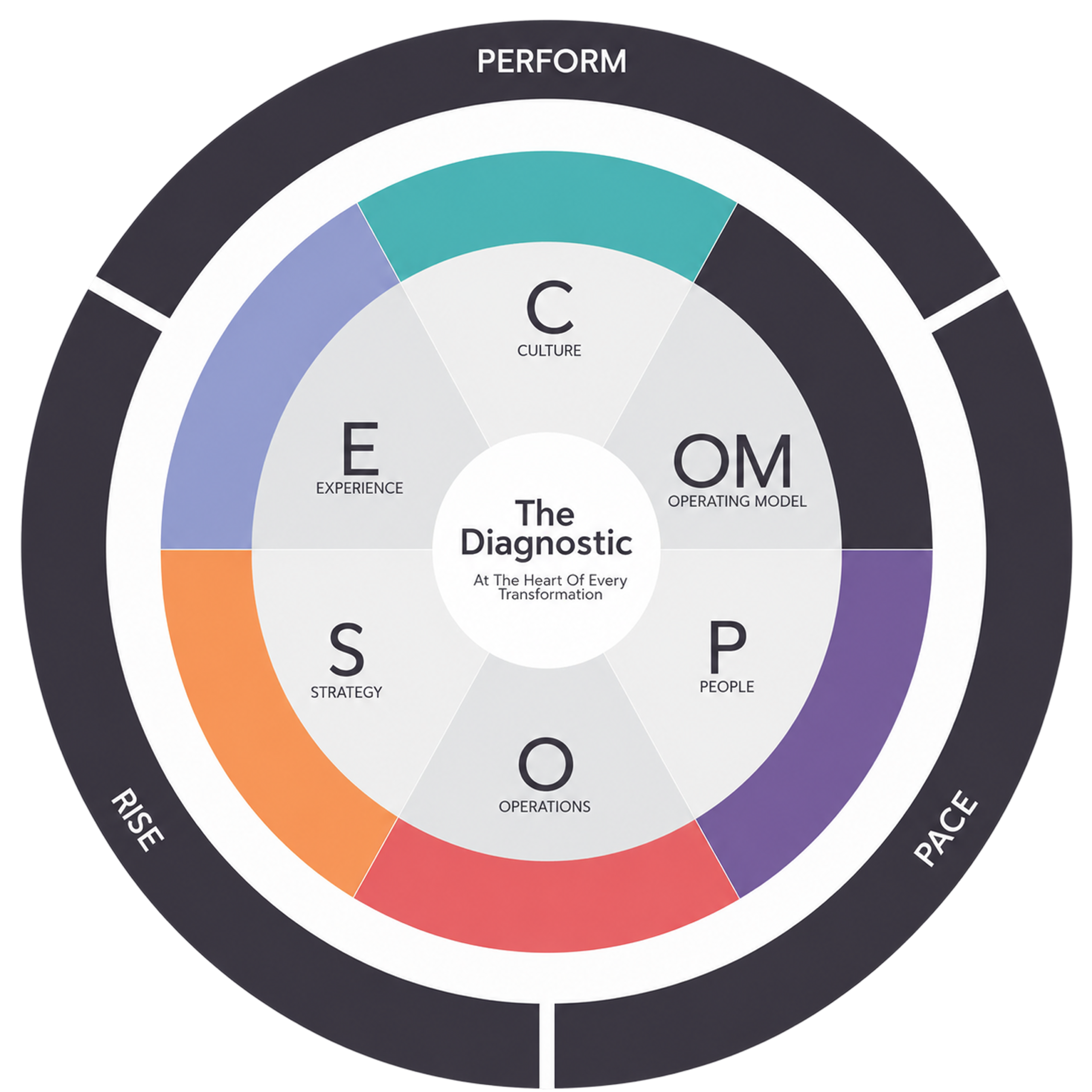
The Diagnostic

Establishes whether process is genuinely the constraint, or whether something upstream is doing the damage.

Explore ›

Let us look at the engine.

It starts with a conversation about where deals stall, where margin goes and which numbers you do not currently trust.

Seraphinite AcceleratorOptimized by Seraphinite Accelerator

Turns on site high speed to be attractive for people and search engines.