
 Skip to content
 Last reviewed: August 2026 | Next review: February 2027

The venue was good, the food was good, the keynote landed, and the feedback scores came back high.
Then everybody went home, and by the second week of February nothing they did was any different from January.
I have run kickoffs ranging from around 200 people to over 1,500, plus a lot of smaller events that nobody would call a kickoff. The pattern holds at every size. People almost always enjoy it. Enjoyment is not the hard part and it is not the point. The hard part is that most attendees leave without a clear idea of what they are supposed to do differently, and that failure is invisible on the night because the room is warm and the scores are good.
“Stage names are the label. The sales process is everything underneath.”
Sales kickoff, SKO, commercial kickoff, revenue kickoff, national sales meeting. The label changes by company and market, the job does not. It is the pinnacle event of the commercial year, the one moment the entire selling organisation is in a room, and you get it once.
Some of it is rightly a celebration of the year that closed. Recognition matters, and the awards should be good. But the weight of the event sits on the year ahead. This is the transmission mechanism for the go-to-market strategy, and in most organisations it is the only occasion where that strategy gets communicated to everybody at once, in the same words, by the people accountable for it.
That framing changes what the event is. It stops being an event with a strategy session in it and becomes a strategy execution programme delivered in event form.
Which is why the go-to-market plan has to be the theme rather than sit underneath one. Not a theme borrowed from a marketing campaign and laid over an agenda with the strategy session slotted into Tuesday morning. The strategy is the thread, and it runs through the keynotes, the breakouts, the awards, the signage, the app, and the conversations people have at dinner without realising the event put them there.
That is deliberate design work, it is what separates events people enjoy from events that change execution, and it is the part most organisations do last.

A note on sales kickoff themes
Most sales kickoff themes fail the same test. Elevate. Ignite. Momentum. One Team. Beyond. All perfectly pleasant, and all of them could belong to any company, in any industry, in any year. A theme that survives being transplanted onto a competitor’s event is not a theme. It is a slogan with a font.
A theme is working when it makes an argument about your year specifically. What has changed in your market, what you are doing about it, and what that requires of the people in the room. If your theme cannot be stated as a sentence with a verb in it, you have picked a word rather than designed a theme.
Which is why most sales kickoff ideas circulating online are the wrong starting point. Icebreakers, energisers, gamified formats, guest speakers, awards formats: these are execution choices and some are excellent, but they answer questions the theme design has not asked yet. Choose the format first and you spend six months reverse-engineering a strategic argument into activities somebody already booked.
I am deliberately not going to lay out the method here. The point is that theme design is a discipline with its own outputs, and it is not the same activity as picking a name or building an agenda.
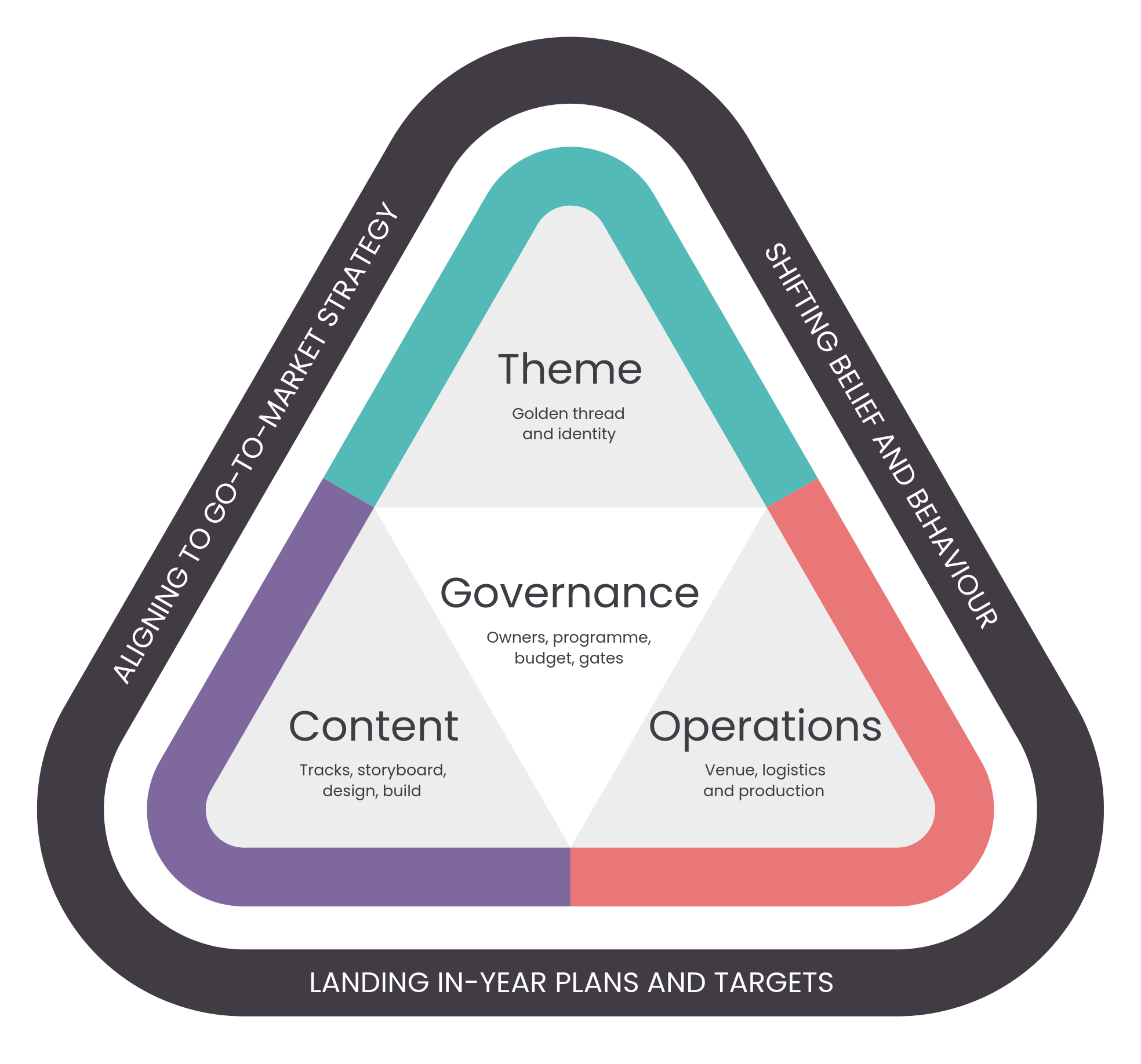
This is the strategic layer and where the golden thread gets built.
What is the story of the year? Not the slogan. The argument: what is changing in the market, what we are doing about it, what that means for each seller, and what specifically has to change in execution by March. Then how that argument holds across three days without the audience noticing they are being taken somewhere.
Everything downstream comes from this. Agenda architecture, which sessions are main stage and which are breakout, what the keynotes carry, how the breakouts reinforce rather than repeat, and what gets recognised in the awards.
It also needs designing as a learning experience rather than a broadcast. People need to be informed, then educated, then given something to practise, then inspired, and those are different modes requiring different session formats and different amounts of time. An agenda made entirely of forty-five minute presentations will transmit almost nothing regardless of how good the presenters are.
Sales kickoff content is a bigger build than almost anybody plans for, and it is where the difference between a designed event and a stitched one shows up first.
Pre-event communications and the pre-read. The registration site. The event app. Main stage decks and their rehearsal cycles. Breakout materials, facilitator guides, workbooks. The interstitial content most people treat as filler. Signage, wayfinding, room dressing, holding slides, the things nobody consciously reads and everybody absorbs.
Each one carries the thread or dilutes it. A holding slide with last year’s campaign visual is a small thing, and forty small things across three days is how a message gets diluted while everybody congratulates themselves on the keynote.
Vendor and partner content sits in here too, and it is the most common leak. Sponsors and technology partners arrive with their own decks and their own narrative. They need briefing to the thread the same way an internal speaker does.
Venue, production, staging, lighting, sound, transport, food and beverage, evening activities, security, on-site technical support, registration flow, room turnarounds.
This is the visible part, and conventional event management is what most people mean when they say they are planning a kickoff. It has to be excellent, because bad logistics destroy an event that is otherwise well designed. Nobody absorbs a strategy message while standing in a forty minute registration queue.
It is not the point of the event, and the bigger the organisation the worse this mistake gets. Budget and attention flow to the visible, measurable, procurement-friendly things. The venue is a contract. The production company is a contract. The theme architecture is somebody’s time, and it loses.
You end up with flawless execution carrying a weak argument.
The pillar in the middle, holding the other three together.
End-to-end programme management with a single owner, a critical path, decision gates, and proper budget management. Not a project plan that appears in month four when the panic starts.
It is a pillar rather than an administrative wrapper because the other three pull against each other constantly. Content deadlines depend on strategy decisions leadership has not made. Logistics lock in months before the content that has to fit inside them. Budget gets committed to production before anybody has costed the content build. Somebody has to hold the shape and force decisions in the right order, with the authority to do it.
Budget control belongs here. Kickoff budgets overrun in the same places every time, and it is nearly always late decisions rather than high prices.
The four pillars do not change between 200 people and 1,500. What changes is the tolerance for error.
At 200 you can recover from a session that is not landing. Past a thousand you cannot, because the logistics of moving that many people mean the agenda is effectively locked once it starts. Larger events need more rehearsal, more contingency and earlier decisions, and they need the theme work done further in advance because more people have to be briefed into it.
The same framework has held for me across internal sales kickoffs, partner events and customer-facing events. The audience changes what the argument is and what a good outcome looks like. It does not change the requirement for a thread, a content plan built from it, logistics that get out of the way, and somebody holding the programme.

Venues for a large kickoff want to be secured around twelve months out, usually working with your events team or agency, and in some markets and seasons that is already tight.
The structural design work, meaning the theme and the agenda architecture, needs to start seven to eight months out, longer if capacity allows. That sounds excessive to anybody who has only seen kickoffs assembled in the final quarter, and it is the difference between a designed event and a stitched one.
What makes it long is not the design. It is that theme design depends on the go-to-market plan being settled enough to build on, and in most organisations it is not settled seven months out. Part of the work is running the design so it absorbs late strategy decisions without unpicking everything.
The alternative is what most organisations do. Book the venue, build the agenda around who wants stage time, commission the content in the last eight weeks, and hope it coheres. It never fully does. It just does not fail visibly enough for anybody to name it.


If your selling organisation spans regions, the design has to account for it rather than accommodate it afterwards.
Language and comprehension change what a main stage session can realistically carry. Participation norms differ: the breakout format that generates strong discussion in one region produces silence in another. Dietary and religious requirements need handling properly rather than as an afterthought on a form. Travel burden is unevenly distributed and affects who arrives able to concentrate. Recognition norms vary more than people expect.
These are small things individually. They compound into whether a significant part of your audience feels the event was built for them or that they were flown in to watch something built for somebody else.
Virtual and hybrid sales kickoffs have their place, usually for regional follow-through or populations who cannot travel. They are not a cheaper version of the main event. Attention behaves differently on a screen, so the agenda has to be rebuilt rather than streamed, and the content requirement goes up rather than down.
I looked for credible independent research on sales kickoff effectiveness while writing this and did not find any worth citing. Almost every measurement framework in circulation comes from a vendor with a product to sell into the post-event gap. Some of those frameworks are reasonable. But the evidence base here is thin compared with almost any other area of sales performance, and anybody claiming a clean answer is selling something.
There is no single number that tells you whether a kickoff worked. What I use instead is three parameters, measured separately, because they fail independently.
Two caveats from experience. Topic choice is more limited than people assume, because room format, timing and audience mix rule out anything requiring sustained individual concentration. And it only works with prework before and reinforcement afterwards. Training delivered cold in a plenary room and never revisited produces attendance data, not capability.
The underlying test sits behind all three, and it is the one in the title of this article. What are people doing differently in the second week of February, and can you evidence it.
I will be straight that I have never solved the second half of that sentence. Too much lands in the same window. The comp plan changes, territories move, managers change, the market does something nobody forecast. Attributing a change in execution to a session somebody sat through in January is close to impossible, and anybody claiming they have isolated it is guessing with more confidence than the data supports.
What I do instead is fix the expectation before the event, in writing, about what should look different by March. It proves nothing about causation. It does force somebody to state what the event is supposed to produce, which most kickoffs never do.
For context on why the stakes are high, the Bridge Group’s 2026 research across 158 B2B companies puts the share of AEs at quota at 48 percent, down from 74 percent in 2012, with average ramp now at 6.2 months. If the kickoff is your primary annual mechanism for transmitting the plan to the people who have to execute it, it is carrying a lot of weight in a system already under strain.
Attendance against invited, and attendance sustained across the full agenda rather than just day one. Budget against plan, and the variance explanation, which usually tells you more than the number. Post-event NPS and structured feedback. These are the easiest to collect and the most commonly mistaken for the answer. High scores tell you the event was well executed and people enjoyed it. Worth knowing, and not the same as effectiveness.
This is the one that matters, and it is why getting the content right is critical. A kickoff is where the year's plays launch. Whatever went on stage has to tie directly back to the numbers, the targets, the quota model, the pipeline generation plan and the specific plays sellers are expected to run. If it does not, you have run a well-produced event about something other than the business. The test is traceability. Take any main stage session or breakout and ask which line of the sales plan it serves. Sessions that cannot answer that were on the agenda because somebody wanted stage time.
Sales kickoff training is the one point in the year with a genuinely captive audience, which makes it the best available vehicle for delivering academy content at scale. Completion rates achieved in the room are far higher than anything you will get through a learning platform in normal working weeks.
Production is where this argument usually gets misread, so to be clear about it.
Energy is part of the point. A commercial selling organisation runs on momentum, and a kickoff is meant to generate some for the year ahead. Production value contributes to that in a way that is real even if it resists clean measurement, and a flat-feeling event undermines a good message.
So production should be rightsized twice. Once to your budget, which is obvious. And once to the level of energy or differentiation you are actually trying to create, which is not, and which is the calculation most organisations skip. The right answer for a business making a significant strategic pivot is different from the right answer for a business continuing a working plan into its third year.
What production is not is the crux of the event. Content is king. Spend against the wow factor you need and no further, then put the remaining budget into the thread, the content build and the follow-through, because that is where behaviour change actually comes from.
A kickoff is not one part of PACE. It is the only moment in the year when all four parts are delivered at once, to the same room, in the same three days.
Plays. The kickoff is where the year’s plays launch. Anchor plays get introduced, the motions get explained, and sellers form their first impression of whether the plays are real or theatre.
Academy. It is the single highest-completion training opportunity you will get all year, and the only one with a fully captive audience.
Content. The event is a content build before it is anything else, and every piece of it either carries the argument or dilutes it.
Engagement. The event itself, and the culture and energy it either generates or fails to.
That is why kickoffs are hard, and why they fail in ways nobody can name afterwards. Four disciplines that normally run on separate timelines, owned by separate people, have to converge on one date and cohere. Weakness in any one of them is invisible on the night and obvious by March.
It is also why this is one of our anchor offerings.
Compose, together with our partners, runs sales kickoffs and commercial events end to end. Whether you call it a sales kickoff, a commercial kickoff, a revenue kickoff or a national sales meeting, the work is the same: event strategy and theme design, the full sales kickoff content build, sales kickoff training design, event management, logistics and production, and on-site support through delivery.
If you are planning next year’s kickoff, or looking at this year’s feedback scores and wondering why nothing changed, get in touch.
Browse more perspectives from our team of operators and advisors.
The best first step is a simple conversation about where your sales organisation stands, and what to fix first. No pressure, no pitch.

A practitioner-led sales transformation practice anchored on the COMPOSE Sales Model®.
Copyright © Compose Sales Partners Limited. COMPOSE Sales Partners, the Compose Sales Partners logos, COMPOSE Sales Model is a trademark and service mark of COMPOSE Sales Partners Limited. PERFORM, PACE, and RISE are proprietary frameworks of COMPOSE Sales Partners. Other brands and product names are the trademarks of their respective companies.

The challenge
An award-winning commercial enablement function had to be designed and built from the ground up, covering plays, academy, content, engagement, and the platform that runs them. The bar was set high. It had to be measurable, evidenced, and connected to revenue outcomes, not a content library.
What was done
· Designed and led the full commercial enablement function as the accountable VP. Owned the operating model and all four Centres of Excellence (Plays and Pipeline Creation, Academy, Content, Engagement).
· Built the three-tier sales play system from Anchor Value Story through Core Value Propositions to Tactical Plays, with bill of materials and activation.
· Built the Pipeline Creation engine. Cadenced prospecting, marketing-sales-product-inside-sales interlock, pipeline coverage as the managed outcome.
· Built the Academy across Foundations (Ready to Sell), Skills by role, and the Leadership Academy with a proprietary hiring framework.
· Architected the content discipline (hero/L1/L2/L3 tiering, governance, decay management).
· Selected and led implementation of the enablement platform. Designed the engagement model (manager rhythms, deal coaching, flagship events) with a single voice across all of it.
Outcome
Internal Innovation Award for the function and approach. Pipeline coverage uplift of 1.7x to 3.2x off a €6.5 million sales kick-off event spanning 1,650 people. Material improvement in onboarding-to-productivity time. Play adoption and content engagement evidenced at function level. A manager layer enabled to coach deals rather than chase forecasts.

The challenge
The corporate sales function needed a new strategy and a partner programme designed to extend reach into segments the direct organisation could not cover economically. The existing partner motion was disconnected from the direct go-to-market, with overlapping accounts, unclear economics, and inconsistent value propositions.
What was done
· Designed the corporate sales strategy. Segmentation, coverage, channel mix.
· Designed and operationalised the partner programme. Tiering, enablement, deal registration, partner business plans, economics.
· Aligned partner and direct motions to remove conflict and create complementary coverage.
· Led the rhythm of business and reporting that gave leadership confidence in partner-sourced and partner-influenced revenue.
Outcome
Coherent partner programme operating in market with clear economics. Partner-sourced and partner-influenced revenue evidenced through structured reporting. Direct and indirect motions complementary rather than competing.

The challenge
Following a major acquisition, two commercial organisations had to be integrated into one without losing the run-rate. Operating models, processes, tools, plays, and ways of working were duplicative, inconsistent, and slowing the combined organisation down. Sellers were navigating two systems and two cultures.
What was done
· Designed the unified commercial operating model post-merger. Segmentation, coverage, organisation design, role architecture, decision rights, governance.
· Designed the unified enablement function using the PACE framework. Single plays system, single Academy, single content discipline, single engagement model.
· Led the lead-to-cash process rationalisation and the supporting architecture decisions.
· Built the rhythm of business and forecast discipline that gave the combined organisation a single source of truth.
· Mobilised the cultural integration alongside the structural one. Recognition, communications, manager activation.
Outcome
Combined commercial organisation operating as one inside the integration window. Orders growth of +2.4 percent representing $6.7 million across more than 2,000 sellers. Sellers operating on a single set of plays, content, and processes across the combined business. Internal Transformation Award.

The challenge
Following a major acquisition, two commercial organisations had to be integrated into one without losing the run-rate. Operating models, processes, tools, plays, and ways of working were duplicative, inconsistent, and slowing the combined organisation down. Sellers were navigating two systems and two cultures.
What was done
· Designed the unified commercial operating model post-merger. Segmentation, coverage, organisation design, role architecture, decision rights, governance.
· Designed the unified enablement function using the PACE framework. Single plays system, single Academy, single content discipline, single engagement model.
· Led the lead-to-cash process rationalisation and the supporting architecture decisions.
· Built the rhythm of business and forecast discipline that gave the combined organisation a single source of truth.
· Mobilised the cultural integration alongside the structural one. Recognition, communications, manager activation.
Outcome
Combined commercial organisation operating as one inside the integration window. Orders growth of +2.4 percent representing $6.7 million across more than 2,000 sellers. Sellers operating on a single set of plays, content, and processes across the combined business. Internal Transformation Award.

The challenge
A multinational B2B business needed to reset enterprise GTM following years of inorganic growth. Coverage was inconsistent across regions, segmentation lacked discipline, the operating model was federated by accident rather than design, and the data architecture beneath the commercial engine had visibility gaps that made forecast and planning untrustworthy.
What was done
· Ran a structured organisational capability assessment across the commercial organisation. The forerunner of the COMPOSE Sales Model Diagnostic™.
· Designed the enterprise GTM strategy and the operating model that supported it. Segmentation, coverage, account tiering, rhythm of business.
· Architected the data and reporting backbone for executive visibility and forecast discipline.
· Led the cross-functional alignment between sales, marketing, product, and finance behind a single plan.
· Mobilised the change across regions, respecting local market nuance while holding a consistent global standard.
Outcome
Revenue scope of £800 million to £1.2 billion across post-merger commercial integration. Material improvement in coverage quality, segmentation discipline, forecast accuracy, and pipeline coverage. Operating model and rhythm of business embedded across all three regions.
 Optimized by Seraphinite Accelerator